

The Phantom Time Hypothesis: Why Three Centuries Aren’t Missing
A popular claim says 614–911 CE never happened. Tree rings, eclipses, Miyake events, coins, and cross-cultural chronicles prove otherwise.
If you’ve ever fallen down an online history rabbit hole, you’ve probably seen the claim that nearly three centuries of medieval history never happened at all. According to the “Phantom Time Hypothesis,” the years 614–911 CE were fabricated, Charlemagne was fictional, and our calendar is off by almost 300 years. This story unravels the moment it is tested against scientific data and global historical records.
The Genesis of a Conspiracy
The idea of a missing block of medieval history was first proposed in 1991 by German author and publisher Heribert Illig. His 1996 book, Das erfundene Mittelalter (The Invented Middle Ages), laid out the architecture of his argument, which gained popular traction in Germany. It tapped into long-standing popular myths about the so-called ‘Dark Ages’ as a mysterious, stagnant void in history, which made the idea more attractive to the public. Popular imagination had long painted the centuries between Rome and the High Middle Ages as an empty void — a misconception Illig exploited. While the book received some scholarly reviews, it was overwhelmingly rejected by historians as fundamentally flawed.
The core of the hypothesis is a conspiracy of breathtaking ambition. Illig alleged that in the late 10th century, the Holy Roman Emperor Otto III and his confidant Gerbert of Aurillac (who would become Pope Sylvester II) colluded to rewrite history. Their supposed motive was to manipulate the calendar so their own reigns would coincide with the auspicious year 1000 CE. To achieve this, they allegedly inserted 297 years of “phantom time” (614 to 911 CE) into the calendar, fabricating entire historical epochs to fill the void.
Illig built his case on three main “pillars of evidence”:
- A Mismatch in the Gregorian Calendar Reform: The quantitative centerpiece of the theory, this claim argues that the 1582 CE Gregorian calendar reform revealed a chronological anomaly.
- A Perceived Scarcity of Evidence: Illig asserted a suspicious lack of reliable archaeological and documentary evidence from the 7th to 9th centuries CE.
- Architectural Anomalies: A subjective argument that Romanesque architecture in 10th-century Europe seemed “too advanced” and too stylistically close to its Roman predecessors.
Deconstructing the Pillars of a False History
The Gregorian Calendar Error
Illig’s central “proof” is based on a fundamental misunderstanding of the 1582 CE calendar reform. He argued that when Pope Gregory XIII corrected the Julian calendar, he removed 10 days to account for accumulated drift. Illig calculated that from the Julian calendar’s implementation in 45 BCE to 1582 CE, the drift should have been 13 days, leaving three “missing” days — or three centuries — unaccounted for.
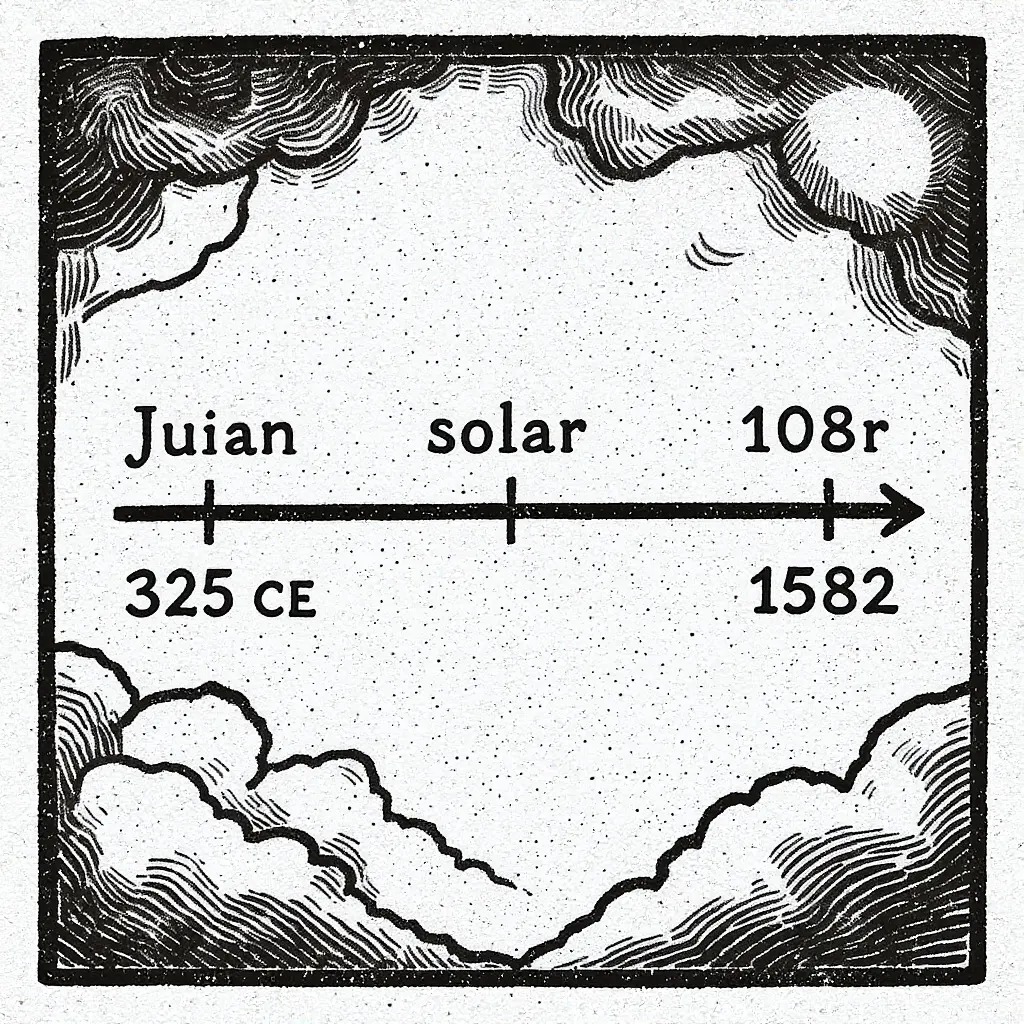
The math, however, tells a different story. The reform’s goal was not to reset the calendar to 45 BCE, but to realign the vernal equinox with the date it held during the Council of Nicaea in 325 CE. This council was the body that established the formula for calculating Easter, the most important feast in the Christian calendar, and its timing is tied to the equinox. Because the Julian year is about 11 minutes longer than the solar year, it drifts one day every 128 years. Over 1,257 years, that produces ~10 days — exactly what Gregory’s reform corrected. Put simply: the drift was exactly what astronomers in 1582 expected, not three centuries’ worth of missing time. Illig’s error was assuming the reform should have corrected drift all the way back to 45 BCE rather than to the Council of Nicaea in 325 CE. There are no missing days or centuries.
Expansion: Medieval astronomers and calendar awareness
Medieval astronomers were well aware of this drift long before 1582. Bede, writing in the early 8th century, noted discrepancies in calculating Easter, while Islamic astronomers developed their own calendar refinements to track lunar months with astonishing precision. The fact that different cultures noticed the same issue undercuts the idea of a hidden, fabricated gap.
The “Scarcity” of Evidence
Illig’s second pillar, the supposed lack of evidence, mistakes the normal challenges of historiography for a conspiracy. While original documents from this period are less common than from later eras, this is a known feature of historical study, not proof of a fabrication. Far from being empty, the 7th–9th centuries produced sources such as the writings of the Venerable Bede in England and the Royal Frankish Annals. Other surviving evidence includes charters from Anglo-Saxon England, coins from the reign of Offa, and Byzantine chronicles like those of Theophanes the Confessor. Archaeological finds such as the Sutton Hoo burial (early 7th century) and Carolingian manuscripts like the Book of Kells (c. 800 CE) further root this period in material reality. Other finds, including Carolingian coins and the Staffordshire Hoard, reinforce the continuity of the age. Historians have developed critical methods to analyze copies of texts, charters, and chronicles, and they are well aware that forgeries were a real issue in the medieval period, often created to legitimize land claims. However, the existence of some forgeries does not logically lead to the conclusion that the entire era is a forgery.
Expansion: Material culture shows a connected world
The Sutton Hoo ship burial alone provides a stunning catalog of craftsmanship: a ceremonial helmet, finely worked gold and garnet jewelry, and imported silverware from Byzantium. Finds like these show an interconnected world, not an empty age. In Scandinavia, the Oseberg ship burial (c. 834 CE) echoes similar themes of wealth, artistry, and ritual, demonstrating cultural continuity across northern Europe during the very centuries Illig claims did not exist.
The Fictional Figurehead: Charlemagne
The most significant casualty of this supposed fabrication was Charlemagne, the legendary King of the Franks. In reality, Charlemagne (c. 747–814 CE) was the king who united the majority of western and central Europe and whose reign sparked the Carolingian Renaissance, a period of cultural and intellectual revival. Erasing him would require unraveling a vast web of interconnected evidence, including standardized currency (the silver denier, minted across his empire), capitularies (legal codes issued in his name), diplomatic correspondence with the Abbasids, papal coronation records from 800 CE, monumental inscriptions, and multiple independent chronicles. His reign was also embedded in wider global currents, from alliances with the Abbasid Caliphate to conflicts with Viking raiders.
Expansion: A living anchor between Baghdad and Aachen
One of the most tangible proofs of these connections is the famous elephant Abul-Abbas, gifted to Charlemagne by Caliph Harun al-Rashid in 802 CE. Such a creature could hardly appear in Europe without extensive diplomatic correspondence, shipping records, and eyewitness mentions — all of which survive. The elephant is more than a curiosity; it’s a living anchor tying together Baghdad and Aachen in the early 9th century.
The Counter-Argument from Architecture
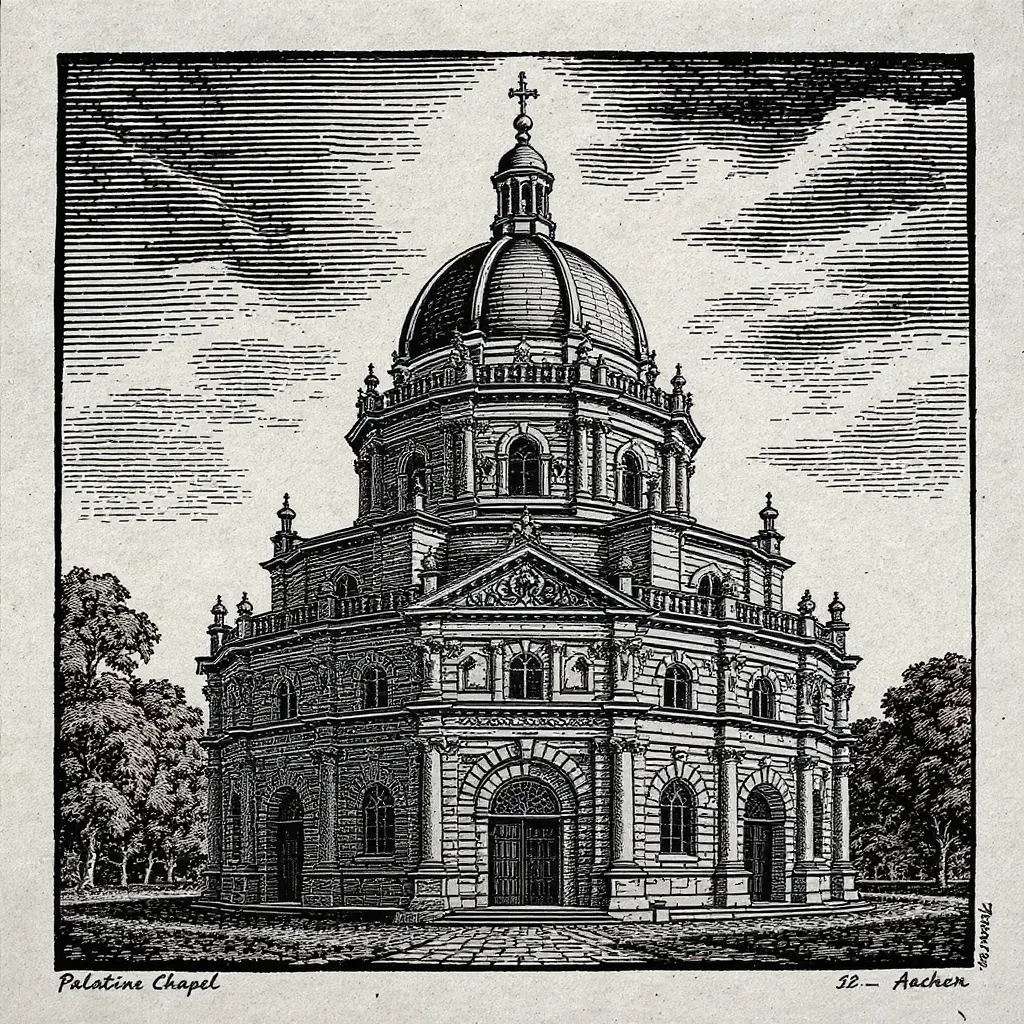
Illig’s claim about architectural styles being “too advanced” is directly refuted by one of the most famous buildings of the era: Charlemagne’s Palatine Chapel in Aachen, Germany (consecrated in 805 CE). The chapel’s design clearly and deliberately draws on earlier Roman and Byzantine models, such as the Basilica of San Vitale in Ravenna, which Charlemagne had visited.
He even had ancient marble, columns, and bronze railings brought from Rome and Ravenna to incorporate into the structure — a practice known as spolia, the reuse of ancient materials as a way of claiming continuity with Rome. At the same time, the chapel showcases distinctly Carolingian innovations, such as its monumental western entrance (westwork) and Frankish construction techniques. The building is not an anomaly that proves a missing gap in time; rather, it is a perfect example of Carolingian rulers consciously blending the legacy of Rome with their own cultural and political ambitions. Far from undermining chronology, architecture shows a conscious Carolingian revival of Rome — exactly what we would expect, not a suspicious anomaly.
Expansion: Continuous development into the Ottonian era
Later Ottonian architecture in the 10th and 11th centuries built directly on Carolingian foundations, expanding westwork facades and experimenting with vaulted interiors. The stylistic evolution across these centuries demonstrates continuity — the slow, observable development of medieval architecture — not an inexplicable leap over “phantom” centuries.
The Scientific Veto: Unbreakable Timelines
Beyond historical records, two independent fields of science provide a definitive and mathematically rigorous refutation of the Phantom Time Hypothesis.
Dendrochronology (Tree-Ring Dating)
Tree rings function like climate barcodes: wide and narrow rings reflect wet and dry years, creating unique sequences that can be overlapped into an unbroken chain. By matching these unique patterns from progressively older wood samples — a technique called cross-dating — scientists can construct a continuous “master sequence” that extends back thousands of years.
This method provides a direct and decisive refutation of the PTH. Multiple, unbroken tree-ring chronologies exist that span the entirety of the alleged “phantom time.” Specifically, the Irish oak chronology extends over 7,400 years, and the Hohenheim oak and pine chronology reaches back more than 12,000 years. There is simply no 297-year gap in this physical record. The method’s accuracy is routinely confirmed; for example, dendrochronology precisely dated the timbers used for the burial chamber of the Danish king Gorm the Old to the felling year of 958 CE. These tree-ring chronologies serve as year-by-year calendars written in wood, leaving no space for a phantom gap.
Expansion: Global alignment of tree-ring records
Importantly, these chronologies are not confined to Europe. Ancient bristlecone pines in North America and Japanese cedar chronologies extend the method globally, and their sequences align seamlessly with the European record. This worldwide consistency makes the idea of a 297-year omission implausible on a planetary scale.
The Testimony of the Stars and Atoms
The predictable motions of celestial bodies function as a tamper-proof clock. Because celestial mechanics are exact, even a 10-year discrepancy would break alignment — let alone 297 years. Multiple solar eclipses recorded by independent civilizations, specifically in Tang China and the Byzantine Empire, align perfectly with modern calculations. The same is true for appearances of Halley’s Comet, whose spectacular pass in 837 CE was documented by observers around the world, including in China, Japan, and Germany.
Furthermore, a different kind of cosmic event provides an even more precise anchor. Known as Miyake events, these “cosmic time-stamps” are massive bursts of cosmic radiation that leave distinct, global carbon-14 spikes in tree rings. Two major Miyake events have been identified and measured in tree rings worldwide: one in 774–775 CE and another in 993–994 CE. These global carbon-14 spikes have been measured in tree rings from Europe, Asia, and North America, locking the events into the physical record and providing definitive, year-specific markers that prove the 8th and 10th centuries occurred exactly when the standard timeline says they did.
World History Doesn’t Exist in a Vacuum
Perhaps the most glaring flaw in the Phantom Time Hypothesis is its profound Eurocentrism. The theory treats European history as if it could be altered without affecting the rest of the world. The historical record proves this to be impossible.
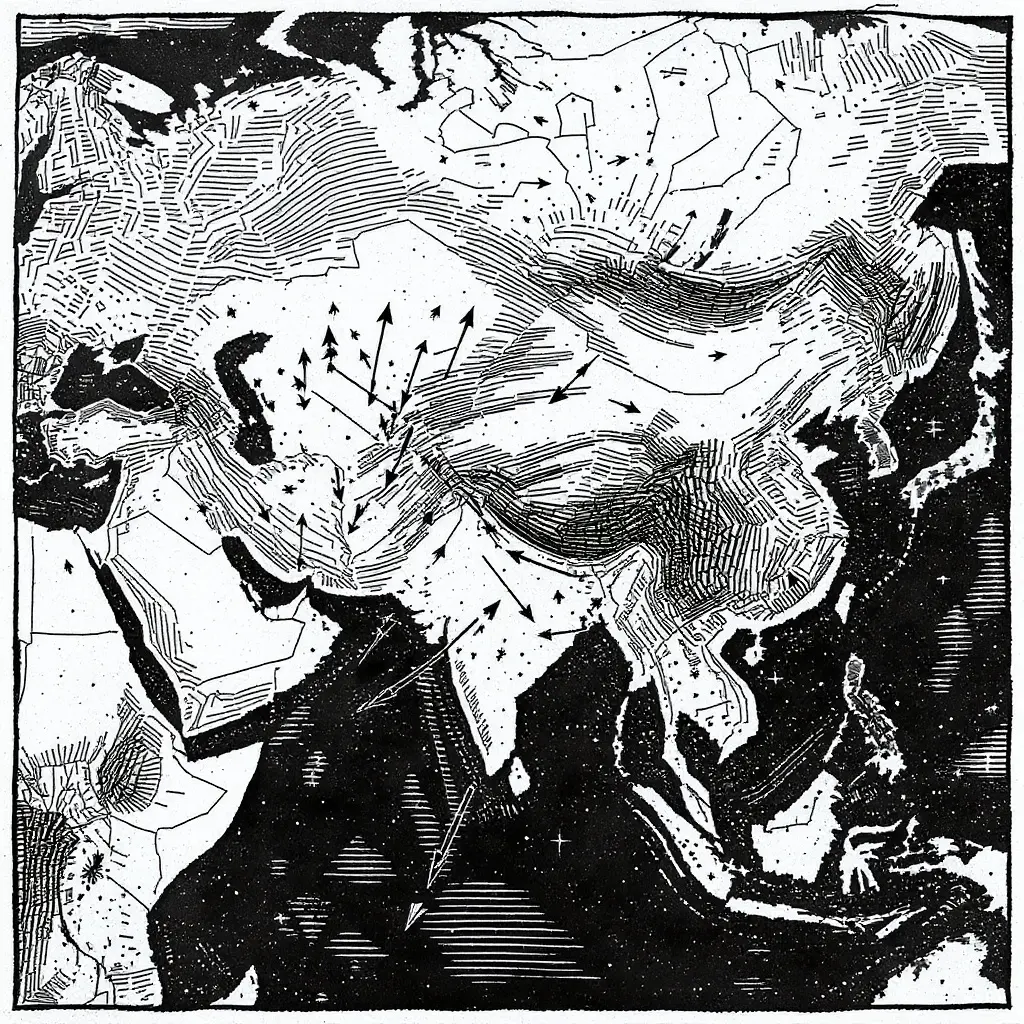
During the “phantom” centuries, the Islamic world was experiencing its foundational era. The Prophet Muhammad lived until 632 CE, the Islamic calendar began in 622 CE, and the Umayyad Caliphate expanded across North Africa and into Spain in 711 CE. Simultaneously, the Tang Dynasty (618–907 CE) was flourishing in China, keeping meticulous historical and astronomical records.
These civilizations were not isolated. The Battle of Talas (751 CE) links Tang China and the Abbasids; the Abbasids’ diplomatic contacts tie directly to Charlemagne; at the same time Viking raids reshaped Carolingian Europe.
Expansion: Papermaking after Talas
The Battle of Talas also had lasting cultural consequences: it marked the moment Chinese prisoners introduced papermaking technology to the Islamic world, a development that would eventually spread west into Europe. A single military clash thus altered the trajectory of global communication — evidence that the 8th century was anything but fictional.
Meanwhile, the Byzantine Empire was in constant interaction with both Islamic and Frankish powers, producing chronicles, coins, and documents that anchor the period firmly in place. Chinese, Islamic, and Byzantine records cross-reference one another in ways that make the removal of centuries not just unlikely, but logically impossible.
Why It Still Appeals
The theory exploits a public perception of the “Dark Ages” as a blank, unknowable period, offering a grand, secret explanation for a complex time in history. It appeals because it makes people feel they’ve uncovered a hidden truth that experts are concealing. It is built on logical fallacies, such as treating lack of evidence as proof of absence, and by stitching together unrelated anomalies into a single grand story.
The Bottom Line
The Phantom Time Hypothesis is not a hidden truth — it’s a case study in how pseudohistory works. The calendar drift claim misreads the Gregorian reform; the “scarcity” argument mistakes normal source limitations for evidence of fabrication. Dendrochronology, astronomy, and cross-cultural histories all show those centuries are real. Erase three centuries in Europe, and you must erase eclipses in China, coins in Baghdad, and the scars of Viking raids in Ireland. The tapestry of history does not permit such edits. History is not fragile; it is reinforced by overlapping records, from chronicles and coins to tree rings and stars. Those centuries are carved into trees, etched into the sky, and inscribed across the world’s chronicles.