

The Planet Has a Secret Basement (And Other Things Geologists Are Hiding From You)

Alright, picture it: you're on a Spirit Airlines flight. You've paid extra for a seat that doesn't recline, next to a man who considers personal space to be a vague, philosophical concept. Your knees are somewhere up by your ears. You are a human pretzel. You've negotiated with your kneecaps. They declined. When the world feels cramped, never have you felt more confined, more utterly convinced that the world is a small, claustrophobic, and deeply unpleasant place.
And as you sit there, a thought drifts into your head: "Don't you ever wish there was just… more space?"
And if you're up at 2 a.m. and you type that question into the internet, you will eventually find a whole group of people who will tell you, with the furious confidence of a man explaining blockchain at a wedding, "Yes. Much more. Inside."
What if I told you that while you're worried about finding a parking spot, there's an entire unused continent inside the planet, complete with its own sun? It's like finding out your tiny studio apartment has a secret, fully-furnished basement the size of Nebraska. This, my friends, is the beautiful, the magnificent, the utterly bonkers myth of the Hollow Earth.
This isn't some new-fangled Reddit theory. This is a classic. A first-ballot Hall of Famer in the Conspiracy Cooperstown. The theory is this: the Earth is not a dense ball of rock. That's just what Big Core—the powerful molten-core lobby—wants you to think. No, the Earth is a hollow shell, a cosmic Kinder Surprise, and inside is a whole other world. This is a planet-rewrite. Here's how it supposedly works.
And like any great conspiracy, it has a sprawling cast of characters: a respectable scientist, a failed shopkeeper turned prophet, a brave American hero, and, of course, the Nazis. So, let's take a journey through the bizarre history, the questionable "evidence," and the beautiful, mundane reality of one of the most enduring myths ever told.
Part 1: The Surprisingly Respectable (and Deeply Weird) Origins
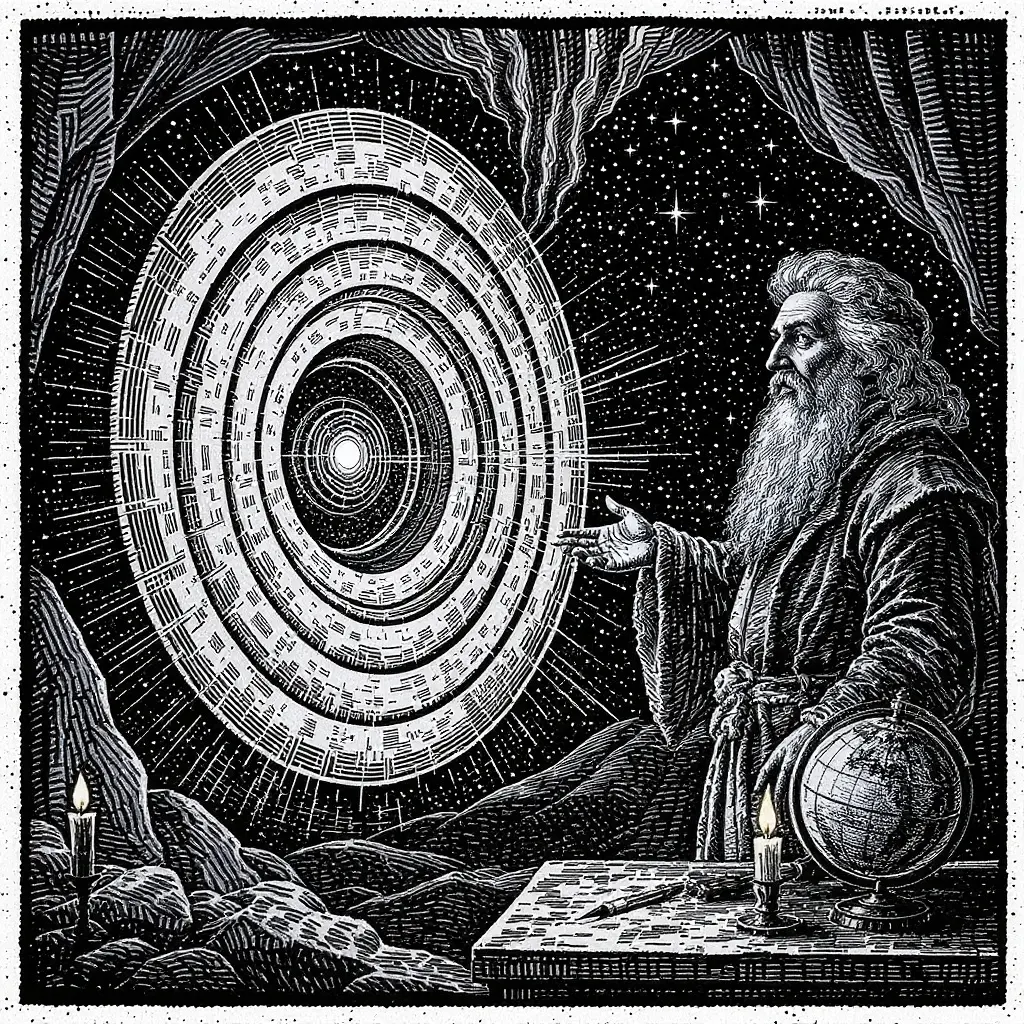
Unlike theories born in the sticky basements of the internet, this one started in the hallowed halls of science. It began with a guy who was, by all accounts, a certified genius. Which makes it so much funnier.
Halley's Hollow
Let's talk about Edmund Halley. Yes, that Halley, of comet fame. In 1692, he proposed nested shells to explain magnetic drift. Magnetic declination is the angle between where your compass points and true north, and it changes because the molten iron in Earth's core convects like a slow, planetary stew; this secular variation is non-uniform, changing at different rates in different regions. Halley's model was a geological Russian nesting doll: a hollow outer Earth containing two smaller, free-floating inner shells and a solid core. He suggested the spaces between were filled with a luminous atmosphere, which would leak out at the poles, causing the aurora borealis. It took another century and a half for scientists like Carl Friedrich Gauss to give us a math toolbox using spherical harmonics to separate the core's deep field from the crust's local magnetic fields, the way a DJ isolates the bass from the vocals.
The Weight of the World
Before we get to the real prophet of the Hollow Earth, you have to understand that by the late 1700s, scientists had literally weighed the planet. Using Isaac Newton's law of universal gravitation and a contraption of lead balls on strings in the Cavendish experiment, they figured out Earth's mass. The average Earth density came out to approximately 5.5 grams per cubic centimeter; granite at the surface is roughly 2.7 grams per cubic centimeter. The missing heft sits below, like a kettlebell in the pantry. Furthermore, spin math(the moment of inertia) matches a dense core, not a balloon; more mass near the center makes spin behave like a figure-skater pulling in their arms. The moment of inertia for Earth is far from what's expected for a uniform sphere and even further from a hollow one.
Symmes Holes
Halley's idea was a scientific curiosity. It took an American war hero and failed shopkeeper to turn it into a crusade. His name was John Cleves Symmes Jr., and in 1818, he mailed this to everyone who would open an envelope:
"To all the world! I declare the earth is hollow, and habitable within… and that it is open at the poles 12 or 16 degrees."
This man was convinced you could just… sail into the planet through giant polar openings, which became known as "Symmes Holes." His proposed budget line items included: two ships, 80 men, and one really long rope labeled 'just in case.' He became the world's first and greatest Hollow Earth influencer, demanding Congress fund his expedition. Congress's response: "We'll study it." Translation: never.
The Verne Effect
For decades, the Hollow Earth was a fringe belief. Then, in 1864, Jules Verne got ahold of it. His novel, Journey to the Center of the Earth, took the core concept and made it cinematic. He wasn't interested in magnetic fields; he was interested in dinosaurs, giant mushrooms, and a mysterious underground ocean. From Verne to pulp-era staples like Edgar Rice Burroughs' At the Earth's Core(1914) to every modern trailer that whispers, "They went too far," the science got quieter. The dinosaurs got louder.
What Real Scientists Were Doing
While the Symmes crowd was busy sketching tunnels to Atlantis, 19th-century geologists were having a completely different, much more productive kind of fun. Charles Lyell was pushing his theory of uniformitarianism—slow forces, big results—establishing that the Earth was ancient and shaped over millions of years. Later, in 1912, Alfred Wegener would propose that continents actually drift; everyone laughed at him until post-WWII sonar mapping revealed the magnetic 'zebra stripes' on the seafloor. Clinched by Vine-Matthews-Morley in 1963, these stripes record the periodic flips in Earth's magnetic field like a giant tape deck, proving that plate tectonics is a heat-engine story. Hot rock rises at ridges, cools, and sinks at trenches—conveyor belts you can stand on. While one group was looking for a shortcut, everyone else was realizing that mountains move slower than your DMV line.
Part 2: The "Evidence" and the Eyewitnesses

Alright, so the theory is out there. But how do you prove it? Well, if you're a believer, the evidence is everywhere… if you squint.
Polar Doors
The cornerstone of the myth is two giant holes at the poles. The "proof" comes from cherry-picked 19th-century anecdotes:
Arctic 'Warm Patch': Explorers reported brief warm spells. Believers call it proof of an inner sun. Scientists point to the Fram Strait, where Atlantic water entering the Arctic can be 2 to 4 degrees Celsius warmer, and to polynyas—areas of open water tens to hundreds of kilometers across kept clear by winds and currents.
Colored Snow: Reports of black or red snow are cited as volcanic ash from inside. The mundane explanation? Red snow is often blooms of the algae Chlamydomonas nivalis (also called “watermelon snow”); black snow is typically soot or dust.
Northbound Fauna: Why would animals migrate north for winter? To reach the inner paradise, of course. Or, it's just known migrations, like that of the Arctic tern, which flies a round-trip of 40,000 to 70,000 kilometers yearly. Hardcore, not hollow.
Symmes Hole Tourism: ‘No refunds if reality occurs.’Battle of the Bad Shapes
It's important to distinguish our conspiracies. A Flat Earther thinks the planet is a pancake. A Hollow Earther accepts the sphere but argues it's a bubble. A scorecard of testable claims on eclipses and gravity: Reality 1, both theories 0. At this rate we'll find the one that thinks it's a croissant.
Byrd's 'Diary'
This is the centerpiece of 20th-century Hollow Earth lore. The story goes that in February 1947, Admiral Richard E. Byrd, a legitimate American hero, did not fly over the North Pole. According to the legend, which reads like a pulp sci-fi novel, he flew into it. It's a story of pulp beats: blonde envoy, crystal city, stern lecture, no fridge magnet. Souvenir count: zero.
Nazis Below
No 20th-century conspiracy skips the Nazis. This post-war myth claims Hitler and his top officials escaped through the South Pole hole to a secret base called "New Swabia." If there's a Fourth Reich HOA down there, you just know they fine you for grass over six millimeters. Heil citation.
Studio-Sun Physics
Lore needs a light and a floor; here's the light. The inner world is lit by a "central sun"—a personal pan sun—that keeps things cozy. But who's paying the power bill? Fusion requires self-gravity to confine plasma at millions of degrees; a grapefruit can't do that. It would radiate away all its heat like a sad toaster and die. If it's a fission lamp instead, you need fuel, shielding, and waste removal. Congratulations, you've invented Chernobyl-But-Make-It-Mood-Lighting. The answer is usually a lot of hand-waving and centrifuges. It's vibes, not physics.
Now the audit: Three levers settle it: mass, heat, and waves...
Part 3: Check (Now with More Seismic Waves)

The truth is less about a shadowy cabal and more about physics, geology, and paperwork being real sticklers for the rules.
Mass & Gravity
Gravity isn't a suggestion; it's the universe's bouncer. Non-negotiable. If the Earth were a hollow shell, it would have a fraction of its known mass. A Hollow Earth cannot match the observed Earth's moment of inertia. Furthermore, inside a hollow sphere, the gravitational pull from all sides cancels out. Hollow Earth gravity is like sound-canceling headphones, but for weight—a net zero inside the shell.
How We Know What's Inside Without Digging
Besides weighing it, how do we know? We basically spy on the planet. GRACE pair satellites watch gravity wiggle as water and rock move seasonally; if there were a mega-cavity, the gravity map would sag like a bad mattress. We map magnetic anomalies to understand the core. We surveil the planet with scales so sensitive they notice rainy seasons.
How Hot Is Down There, Really?
As you dig down, the temperature increases at a rate called the geothermal gradient (25 to 30 degrees per kilometers near the surface, lower beneath stable cratons). . By the time you get to the core, the temperature is estimated to be approximately 5,400 degrees Celsius. The core pressure is about 3.6 million atmospheres—like a mountain on a postage stamp. At depths around 100 kilometers, minerals like olivine change phase into denser spinel structures, like ice turning to water but solid-to-solid. The solid inner core may even rotate a hair faster or slower than the mantle. Geophysicists call this 'not boring.'
Seismic X-Ray
This is the nail in the coffin. Earthquakes: the planet's unsolicited medical imaging. When an earthquake occurs, it sends P-waves and S-waves through the planet. S-waves stop at the outer core; P-waves refract through it. This creates a massive "shadow zone" for S-waves, proving the Earth has a liquid outer core. We even track wave families with alphabet soup names that skim or pierce the core—think 'text message receipts' from the deep. Some of these waves arrive a smidge early traveling north-south versus east-west, hinting at a likely hexagonal close-packed iron alignment deep inside. Tomography stacks thousands of quakes to image plumes under places like Iceland or Hawaii—hot upwellings from the mantle, not freight elevators to Shambhala.
The Byrd 'Diary' Debunked & No Polar Holes
Byrd's real flight logs show headings and weather—not jungles or mammoths. The "secret diary" appeared decades after his death and is treated by historians as fiction. Finally, the giant holes. Polar-orbit satellites crisscross the caps daily. No 1,400-mile skylight—just ice and bad weather.
Actual Holes That Exist
To be fair, the Earth does have some impressive holes. China's Xiaozhai Tiankeng sinkhole, Slovenia's karst systems, Mexico's cenotes, and Vietnam's Sơn Đoòng cave (the largest by volume) with its own weather. Hawaiian lava tubes run for miles. Mammoth Cave is 400-plus miles of limestone mazes. These are your secret rooms. They are real, mapped, and bat-approved. Bring a headlamp, not a mammoth.
Why Inner-Earth Life Is Hard
Even if you could live inside a hollow shell, what would you eat? Life needs energy gradients. On the surface, we get a giant, free fusion reactor in the sky. Down deep, you get chemolithotrophs—microbes that eat rock chemistry, like hydrogen from water-rock reactions, sulfides, and iron. The energy is poor. It's enough for slime, not for steaks. If mammoths graze, show me the sunlight or the subsidy. Great for microbes, bad for brunch.
Neutrinos and Muons
We have other ways of peeking inside things. In principle, neutrino paths reveal bulk density, and current detectors already hint at this. Muons image mountains and pyramids; muon radiography has mapped volcanoes and even the Great Pyramid's hidden voids. If we had a cavern the size of Nebraska, the flux would tattle, though resolution is coarse for Earth-wide density.
So Why Do We Want to Believe?

No mass gap, no thermal budget, no seismic voids. So, why does the Hollow Earth theory stick around? Because it's a story about hope. And about space.
The world can feel small, mapped, and boring. You can pull up Google Earth and zoom in on any street corner. The romance of the unknown has shrunk. But the idea of a vast, unexplored frontier inside our own planet is intoxicating. It means the world is still full of big, wonderful secrets.
It's also a story born of a specific time. Once all the continents were mapped, the only place left for a grand, romantic adventure was inward. It's so much easier to believe in one big, hidden paradise than to learn about 150 years of incremental discoveries in seismic wave technology. One is an action movie with dinosaurs and Nazis. The other is a textbook.
So the next time you feel cramped on a crowded subway, you can comfort yourself with the thought of a whole other world beneath your feet, lit by a tiny personal pan sun, where mammoths still roam. It's almost certainly not there. But it's a much nicer thought than the one about the guy next to you listening to his music too loud. Keep the personal-pan-sun in your heart; keep tomography in your toolkit. Maybe Big Core's PR is insufferable, but their physics has legroom. And in the end, isn't that what conspiracies are for? To make the world feel a little bigger, a little more mysterious, and a little less like a crowded Spirit Airlines flight.